Understanding the Gem Economy
Master the gem board mechanics in Splendor Duel. Learn optimal gem collection patterns, denial strategies, and how to build compound advantage through permanent bonuses.
13 min read
The gem board is the beating heart of Splendor Duel, and understanding its economy is what separates players who win consistently from those who feel like they are just reacting to whatever shows up. Unlike the original Splendor, where gem tokens sit in neat stacks and anyone can grab what they need, the Duel version forces both players to share a single board of gem tokens arranged in a specific pattern. This seemingly small design choice transforms every gem collection decision into a spatial puzzle layered on top of a resource management problem. The tokens you take, the tokens you leave behind, and the tokens you force your opponent to deal with are all intertwined. Mastering the gem economy means thinking about all three dimensions at once. If you are new to Splendor Duel, start with our beginner's guide for an overview of the rules and core concepts.
The Gem Board: Layout and Refresh
The gem board in Splendor Duel is a 5x5 grid that holds 25 tokens at full capacity. At the start of the game and after tokens are removed, the board is replenished from a bag, filling empty spaces with randomly drawn tokens. The five gem colors (white, blue, green, red, and black) appear alongside 2 pearl tokens and 3 gold tokens, each with different frequencies and strategic implications. Because the refill is random, the board state after your turn is partially unpredictable, which means you cannot perfectly plan two turns ahead based on what gems will be available. However, you can plan around what is currently on the board right now and make probabilistic judgments about what is likely to appear.
The spatial arrangement matters enormously because of the line-based collection rules. Tokens that are adjacent form potential collection groups, and the specific geometry of what is available constrains both your options and your opponent's. Before making any gem decision, scan the full board. Look at which colors cluster together, where the gold tokens sit, and what lines of three different gems are available. Strong players develop a habit of reading the board before every turn, not just glancing at the colors they personally need.
The Three Gem Collection Options
Every turn in Splendor Duel gives you a choice among several actions, and three of those involve collecting gems from the board. Each option has distinct strategic characteristics, and knowing when to use which one is foundational to good play.
Option 1: Take Three Different Gems in a Line
You may select three tokens that form a straight line on the board (horizontal, vertical, or diagonal) provided all three are different colors. This is the highest-volume gem collection option, netting you three tokens in a single turn, and it should be your default choice when viable. The constraint is that the three must be different colors and must form an unbroken line, so the board geometry dictates which combinations are actually available on any given turn. Before your turn begins, mentally scan for all valid three-gem lines and evaluate which one best advances your purchasing plan.
The power of this option is raw throughput. Three gems per turn means you can potentially buy a level-one card in as few as two collection turns, or contribute meaningfully toward a level-two card. The weakness is that you don't get to choose freely; you are locked into whatever lines the board offers. Sometimes the board simply does not present a line that gives you three colors you actually need, and forcing a suboptimal three-gem take just for volume is often worse than pivoting to another option.
Tip: When you spot a line that gives you two gems you need and one you don't, it is almost always worth taking. The two useful gems plus one "wasted" gem is still better throughput than most alternatives, and that extra gem might become relevant later or can push you toward the 10-token hand limit to force a useful discard.
Option 2: Take Two Gems of the Same Color
You may take two adjacent tokens of the same color. This option sacrifices volume (two gems instead of three) in exchange for color precision. When you desperately need a specific color and the board happens to have two of that color sitting next to each other, this is your move. It is particularly strong in the mid-game when your purchasing plans have crystallized and you know exactly which colors you are short on.

Consider a scenario where you need three red gems to buy a high-value level-two card. The board has two reds adjacent to each other. Taking both in one turn gets you two-thirds of the way there, which is dramatically better than hoping a valid three-gem line includes even one red. The cost of reduced volume is real, but targeted collection frequently outperforms scattershot accumulation, especially when you are racing toward a specific purchase.
Gold Tokens: Obtained Through Reservation
Gold tokens cannot be taken from the board through normal gem collection; the rules explicitly prohibit this. The only way to obtain a Gold token is by reserving a card: you take a Gold token from the board, then take a Jewel card from the pyramid or the top of a deck into your hand. Gold tokens are wild and substitute for any color when purchasing cards, making them extremely flexible.
The gold token is deceptively strong. It doesn't just fill one gap; it fills whatever gap ends up being most important at the moment you spend it. If your plan shifts because your opponent buys the card you were targeting, gold seamlessly adapts to your new plan. Reserving is worth considering when the board doesn't present good gem lines for your colors, when you want to lock in a key card, or when the wild flexibility of gold would let you make a critical purchase next turn.
Tip: Gold tokens are scarce: there are only 3 in the game. Each reservation that claims one is a meaningful resource decision. Leaving gold on the board for your opponent to claim via their own reservation is a gift; they gain the same flexibility you passed up.
Gem Denial: The Offensive Side of Collection
Every gem you take is a gem your opponent cannot take. This is obvious in theory but easy to forget in practice, because most players focus on their own purchasing plans and treat the opponent as background noise. In Splendor Duel, the shared board makes denial a first-class strategic tool that you should be considering on every single turn.
Effective denial starts with reading your opponent. Look at the cards available for purchase, consider which ones your opponent is likely targeting, and note which gem colors they have been collecting. If your opponent has been stockpiling green and white gems, they are almost certainly eyeing a card that costs green and white. If the board has a cluster of green tokens, taking one or two of them (even if green is not your primary color) can delay their plan by a full turn or more. In a game that typically lasts 15-20 turns total, costing your opponent a single turn is a significant swing.
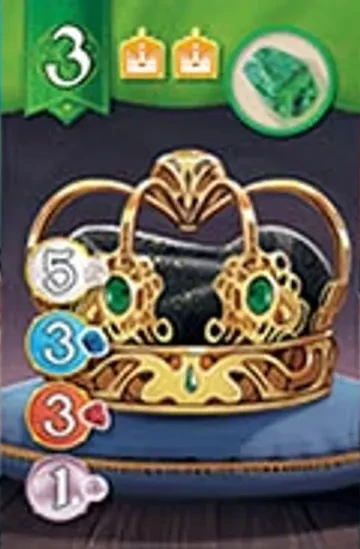
Denial is especially potent in the late game when both players are close to victory conditions. Our guide on reading your opponent covers how to identify exactly when to shift from building to blocking. If your opponent needs one more blue gem to buy a card that would give them their 20th prestige point or a third crown, taking that blue gem is effectively worth infinite value; it is the difference between winning and losing. Always be aware of your opponent's proximity to victory and shift toward aggressive denial when the game is tight.
Passive vs. Active Denial
Not all denial requires sacrificing your own plan. Often, you will find that two or three collection options advance your plan roughly equally, but one of them happens to also remove a token your opponent needs. This is passive denial, and it should be your tiebreaker whenever two options are close in value for you personally. Active denial (taking gems you have no use for purely to hurt your opponent) is riskier and should be reserved for critical moments when the tempo cost is justified by the disruption.
Gem Efficiency: The Turns-to-Value Equation
Every turn you spend collecting gems is a turn you are not buying cards, reserving cards, or taking other actions. This means gems have an implicit cost measured in tempo, and the central efficiency question of Splendor Duel is: how many turns of gem collection does it take to buy a card, and is that card worth the turns invested?
Level-one cards are cheap, typically costing 3-6 gems total, meaning you can often buy one after a single collection turn if your existing bonuses and hand gems align. Level-two cards all cost exactly 7 gems total but offer better prestige and stronger bonuses. Level-three cards are expensive, requiring 8-12 gems in specific colors, but they carry significant prestige and sometimes have crowns. The efficiency calculation is straightforward: a level-one card bought for one collection turn is one turn per card. A level-three card that requires three collection turns is also one card per three turns, but it yields dramatically more prestige per card.
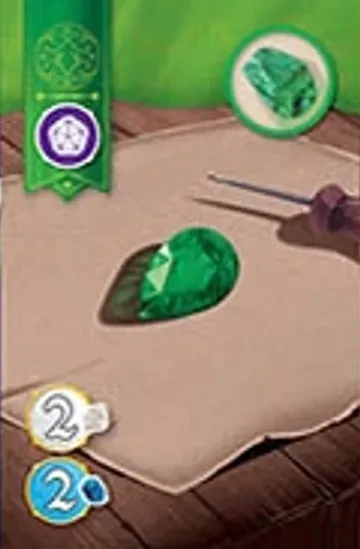
The key insight is that raw gem collection turns are not the only input. Permanent bonuses from previously purchased cards reduce future costs, which means each subsequent purchase becomes cheaper in gem-turn terms. This is the compound advantage engine that the best Splendor Duel players exploit relentlessly. For more on how to choose which cards to buy and when, see our card selection strategy guide.
When to Collect vs. When to Buy
A common mistake is continuing to collect gems when you can already afford a useful card. Every turn you spend hoarding gems beyond what you need is a wasted turn. If you can buy a card that gives you a permanent bonus, buy it immediately; the bonus will pay dividends on every future purchase. The only exception is when buying now would leave you unable to afford a significantly more valuable card next turn that you are confident will still be available. That scenario is rare; in general, buy early and buy often.
Conversely, do not rush to buy a card just because you can afford it if that card does not meaningfully advance your strategy. Buying a card with a white bonus when your entire plan revolves around red and green costs you a turn of gem collection and gives you a bonus you won't use. Not every affordable card is worth purchasing.
Permanent Bonuses and Compound Advantage
The single most important economic concept in Splendor Duel is compound advantage through permanent bonuses. Every card you purchase gives you a permanent bonus in one gem color, effectively reducing the cost of every future card that requires that color by one. This discount is permanent, applies to every future purchase for the rest of the game, and stacks with other bonuses of the same color.
Think of it in concrete terms. Suppose you buy two cards with blue bonuses in the early game. For the rest of the game, every card you buy that costs blue gems costs two fewer blue gems from your hand. A level-two card that costs three blue and two white now effectively costs just one blue and two white for you: a total of three gems instead of five. That is a 40% discount, and it compounds further with every additional bonus you acquire. Players who prioritize early bonus acquisition create a snowball effect where their later turns become dramatically more efficient than their opponent's.
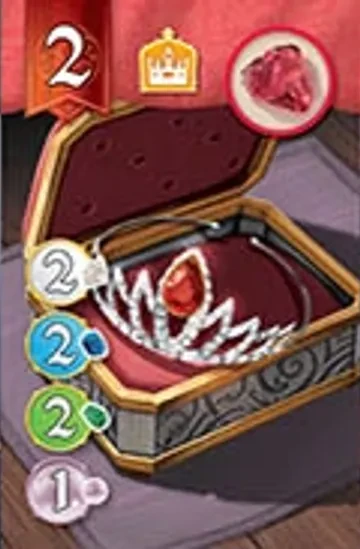
This is why the early game should focus heavily on buying cheap level-one cards that provide bonuses aligned with your planned level-two and level-three purchases. You are not buying those level-one cards for their prestige; most level-one cards give zero or one prestige point. You are buying them for the economic engine they represent. Two or three well-chosen level-one cards purchased in the first few turns of the game can reduce your total gem collection burden by 30-50% across all remaining purchases.
Tip: Before the game begins, scan the available level-two and level-three cards and identify which gem colors appear most frequently in their costs. Prioritize acquiring bonuses in those colors first; your early investments should serve your late-game purchases.
Advanced Board Control
At the highest level of play, gem collection transcends simple resource acquisition and becomes a tool for controlling the board state. Advanced players think not just about what they are taking, but about what the board looks like after their turn and what options it presents to their opponent.
Consider the concept of board shaping. When you take three gems in a line, you leave a specific pattern of gaps on the board. Those gaps will be refilled randomly, but the remaining tokens form new adjacencies and new potential lines. Sometimes, taking a slightly suboptimal line for yourself creates a board state where your opponent has no good three-gem lines available, forcing them into a less efficient two-gem or one-plus-gold turn. This kind of positional thinking is difficult to execute consistently, but even occasional awareness of it provides an edge.
Another advanced concept is tempo awareness around the gem bag. The bag contains a fixed distribution of tokens. As the game progresses and tokens are removed from the bag (gems spent on purchases go back to the bag, but the board refill is constant), you can develop a rough sense of which colors are more or less likely to appear on refill. If many blue tokens have been purchased onto cards and are therefore out of circulation, the board is less likely to refill with blue, making existing blue tokens on the board more valuable.
Pulling It All Together
The gem economy in Splendor Duel rewards players who think several turns ahead, who balance their own acquisition with disrupting their opponent, and who understand that the most important resources are not the gems in your hand but the permanent bonuses on your purchased cards. Understanding the gem economy is just one piece of the puzzle. See our guides on opening strategy, card selection, and win conditions to build a complete strategic picture. You can also browse every card or use the card comparison tool to evaluate specific cards side-by-side. Every turn, ask yourself three questions: What is the most efficient collection option for my current plan? Does any available option also deny my opponent something they need? And is there a card I can buy right now that would improve my economy for future turns? If you consistently find strong answers to all three, you will find yourself winning more games and winning them faster. The gem board is a puzzle, and the player who solves it most elegantly takes the victory.