Cards That Win Games
What do winning Splendor Duel players actually buy? We analyzed 354 competitive games to reveal the card purchase patterns that separate winners from losers.
13 min read
What Winners Actually Buy
Theory is valuable, but data is better. We analyzed 354 competitive Splendor Duel games and tallied every single card purchased by the winning player. The results paint a clear picture of what a winning tableau looks like, and some of the findings challenge conventional thinking about card priorities.
The average winner buys roughly 17 cards per game and claims about 1.5 Royal cards on top of that. The breakdown by level is striking: around 10 of those 17 cards are Level 1, about 4 are Level 2, and roughly 2 are Level 3. If you have been treating Level 1 cards as stepping stones to the "real" purchases at higher levels, this data should change your perspective. Winners do not just dip into Level 1 for a couple of bonuses and move on. They buy heavily at Level 1 because that is where the engine lives.
If you are new to the game, start with our beginner's guide before diving into the numbers here. For a framework on evaluating individual cards, see our card selection strategy guide.
Level 1: The Engine That Drives Everything
Level 1 cards account for nearly 60% of all winner purchases. Within that group, five distinct card types emerge, and their relative popularity reveals a clear priority order.
Crown Cards: 2.5 Per Game
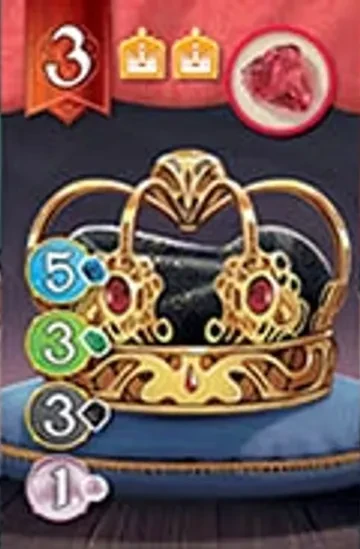
The most purchased card type in the entire game is the Level 1 crown card: three gems of one color, one crown, one bonus, zero points. Winners buy an average of 2.5 of these per game, more than any other single type. That is not a typo. The cheapest crown-bearing card in the game is also the one winners reach for most often.
The appeal is straightforward. At a cost of just three gems, these cards are affordable as early as turn two. They provide a permanent bonus that discounts future purchases, and the crown feeds the crown victory path while also pushing you toward Royal card thresholds at 3 and 6 crowns. A single card that costs three gems, provides engine value, and advances a win condition is remarkable efficiency. Two or three of them form the backbone of most winning tableaux.

TakeGemOfSameColor Cards: 2.1 Per Game
The second most popular type is the Level 1 card that costs two gems of one color plus two of another, with the TakeGemOfSameColor ability. Winners buy about 2.1 of these per game. The ability lets you immediately take a gem matching your new bonus color from the board, which effectively refunds part of the purchase cost and accelerates your next buy. These cards provide both a bonus and a tempo boost, making them excellent early purchases that keep your momentum going.
TakeAnotherTurn Cards: 2.0 Per Game
Close behind at 2.0 per game are the TakeAnotherTurn cards, costing two plus two plus one pearl. As our opening strategy guide explains, these are the most popular first purchase for good reason: the extra turn is enormously powerful in a game that lasts only 15 to 25 turns. The pearl cost makes them slightly harder to acquire than the other Level 1 types, but winners still buy two of them on average. That means winning players are gaining roughly two free turns per game from Level 1 abilities alone.
Four-Color Cards: 1.9 Per Game
The vanilla Level 1 cards (one gem each in four colors, no ability, no crown) are purchased at 1.9 per game. Their low popularity relative to the ability and crown cards is telling. These cards are the easiest to buy because the distributed cost works with almost any gem combination, but they provide nothing beyond a bonus. Winners buy them when the board does not offer a better option, not as a first choice.
One-Point Cards: 1.7 Per Game
The Level 1 cards that cost three plus two gems and carry one prestige point round out the group at 1.7 per game. These are the most expensive Level 1 cards (five total gems), and despite carrying a point, they are the least popular of the five types. The higher cost delays your engine by roughly one turn compared to cheaper alternatives, and winners would rather have the ability or crown from a cheaper card than the single prestige point from an expensive one.
Takeaway: Winners prioritize crowns and abilities over points at Level 1. The cheapest cards with extra benefits outperform the most expensive cards with raw points.
Level 2: The Bridge to Victory
Winners purchase about 4 Level 2 cards per game, spread across several types with clear favorites.
The 2-Point Crown Cards: 1.2 Per Game
The most popular Level 2 type costs two plus two plus two plus one pearl, gives two prestige points, one crown, and a bonus. Winners buy 1.2 of these per game. This is the quintessential "double duty" card described in our card selection strategy guide: it advances your prestige score, your crown count, and your engine simultaneously. At seven total gems (including a pearl), it is expensive, but the return is outstanding.
StealGem Cards: 0.9 Per Game
The Level 2 StealGem cards (cost four plus three, one prestige point) appear at 0.9 per game. The steal ability is a two-gem swing: you gain one and your opponent loses one. Combined with a bonus and a point, these cards provide offense and disruption in a single purchase. They are particularly strong in the mid game when denying a specific gem can delay your opponent's key purchase by a full turn.
Double-Bonus Cards: 0.7 Per Game
The Level 2 cards that provide two bonuses of the same color (cost five plus two, one prestige point) show up at 0.7 per game. Two bonuses in one purchase is a massive engine accelerator. If you already have one bonus in that color, a double-bonus card gives you three total, often making Level 3 cards in that color nearly free. These cards are particularly important for players pursuing the color victory condition.
Privilege Cards: 0.7 Per Game
The GainPrivilege cards (cost four plus two plus one pearl, two prestige points) appear at 0.7 per game. The privilege ability lets you take an extra gem from the board on a future turn, which is solid value but less immediately impactful than StealGem or TakeAnotherTurn.
Gold Cards and Expensive Associates
The bottom of the Level 2 rankings tells an equally important story. The Level 2 gold card (six plus one pearl, five prestige points, no bonus) is purchased only 0.09 times per game. That means roughly one in eleven winners buys this card. Five points is an enormous single-card contribution, but the lack of a bonus means it does nothing for your engine. Winners overwhelmingly prefer cards that keep their engine growing, even if the raw point value is lower.
The two-crown Associate cards (six plus one pearl, zero points, two crowns) appear at just 0.11 per game combined. Despite carrying two crowns each, their high cost and lack of prestige points make them a niche pick. Winners who buy them are typically deep into a crown strategy and need the final push to 10.
Level 3: Closing the Game
Winners purchase roughly 2 Level 3 cards per game, and the type distribution reveals which closers they prefer.
The 3-Point 2-Crown Cards: 0.9 Per Game
The most popular Level 3 type costs five plus three plus three plus one pearl, gives three prestige points, two crowns, and a bonus. Nearly one per game. These cards are the ultimate multi-axis threat: three points toward prestige, two crowns toward the crown victory, and a bonus that still matters even in the late game. Buying one of these can simultaneously push you closer to all three win conditions. Our win conditions guide explains why maintaining pressure across multiple paths is so powerful.
The 4-Point Cards: 0.9 Per Game
The Level 3 cards that cost six plus two plus two, give four prestige points, and a single bonus appear at 0.9 per game. These are pure prestige closers. Four points is a massive single-turn contribution, and the relatively simple cost structure (heavy in one color, light in two others) makes them achievable with a focused engine. Players on the prestige path often target these specifically.
The Expensive Closers
The three remaining Level 3 types are all eight-cost cards, and they are purchased far less frequently:
- Associate TakeAnotherTurn (8 cost, 3 points, associate): 0.19 per game. Roughly one in five winners buys this card. It is expensive but the extra turn at Level 3 can seal a game.
- 3-Crown Associate (8 cost, 0 points, 3 crowns, associate): 0.09 per game. A crown-strategy finisher, but rare because three crowns without any points is a steep tradeoff.
- 6-Point Gold Card (8 cost, 6 points, no bonus): 0.08 per game. The single highest-point card in the game, yet winners almost never buy it. Six points is impressive, but eight gems with no bonus and no crowns is a terrible rate of return when you factor in the turns spent collecting those gems. Only about one in twelve winners touches this card.
Takeaway: Winners prefer Level 3 cards that combine points with crowns. Pure point cards and pure crown cards both underperform the hybrid options.
Royal Cards: Free Points, If You Earn Them
Winners claim an average of 1.56 Royal cards per game, meaning most winners earn at least one and many earn two. The distribution across the four Royals is far from even.
| Royal Card | Points | Ability | Per Game | |---|---|---|---| | TakeAnotherTurn | 2 | Extra turn | 0.63 | | StealGem | 2 | Steal opponent's gem | 0.57 | | 3-Point Royal | 3 | None | 0.24 | | GainPrivilege | 2 | Gain a privilege | 0.11 |
The TakeAnotherTurn Royal is claimed in nearly two-thirds of winning games. Combined with the Level 1 and Level 3 TakeAnotherTurn cards, it is clear that extra turns are the single most valuable ability in the game. The StealGem Royal follows closely behind. The 3-point Royal with no ability is claimed less often despite being worth more raw points, because players need 6 crowns to trigger it (versus 3 for the first Royal), and many games end before either player reaches that threshold.
The GainPrivilege Royal is claimed in only about one in nine winning games. This is the least impactful Royal ability, and the data confirms it. A privilege is worth roughly one extra gem on a future turn, which pales in comparison to an entire extra turn or a two-gem swing from stealing.
What Winners Avoid
The data is as revealing about what winners do not buy as what they do. Three patterns stand out.
Gold cards are rarely purchased. Across all three levels, gold cards (those with no bonus) are at the very bottom of purchase rates. The Level 1 gold card (3 points) appears at 0.12 per game, the Level 2 gold card (5 points) at 0.09, and the Level 3 gold card (6 points) at 0.08. Combined, fewer than one in three winners buys any gold card at all. The lesson is unambiguous: points without engine contribution are not worth the investment. Every card slot in your tableau should ideally provide a permanent bonus.
Expensive Associates are niche picks. While the cheaper Associate cards (Level 1, costing two plus two plus one plus one pearl) appear at a respectable 0.54 per game, the expensive ones at Level 2 and Level 3 (costing six to eight gems) are purchased very rarely. Their high cost and specialized role (often serving crown strategies) limit their appeal to situations where a player is already committed to a specific path.
The Privilege ability is the weakest. Whether on a development card or a Royal, GainPrivilege consistently underperforms the other abilities. It is not bad, but when you compare it to TakeAnotherTurn (a full free turn) or StealGem (a two-gem swing), a privilege that gives you one extra gem on a future turn simply cannot compete.
Building a Winning Tableau
Based on the data, a typical winning tableau looks something like this:
- 2-3 Level 1 crown cards (three-cost, one crown): your engine foundation and crown base
- 2 Level 1 ability cards (TakeAnotherTurn or TakeGemOfSameColor): tempo and engine
- 2 Level 1 vanilla cards (four-color or one-point): filling out the bonus spread
- 1 Level 2 crown card (the 2-point, 1-crown type): bridging points and crowns
- 1-2 Level 2 ability cards (StealGem, double-bonus, or Privilege): mid-game power plays
- 1-2 Level 3 cards (preferably the 3-point 2-crown or 4-point types): closers
- 1-2 Royal cards (earned through crown accumulation): bonus points
This is not a rigid blueprint. Every game is different, and the card market will dictate your specific purchases. But the proportions are remarkably consistent across hundreds of winning games. Winners build broad Level 1 engines, buy a few strong Level 2 cards in the mid game, and close with one or two well-chosen Level 3 purchases.
Takeaway: If your tableau does not include at least six or seven Level 1 cards by the mid game, you are probably underinvesting in your engine. The data shows that winners never skip this step.
Key Takeaways
- Level 1 cards are not just the opening. Winners buy 10 of them per game. They are the single most important card level in the game.
- Crowns and abilities beat raw points. The cheapest crown card is the most purchased card in the entire game, while high-point gold cards are among the least purchased.
- TakeAnotherTurn is the strongest ability. It dominates at Level 1, Level 3, and among Royal cards. Plan your game around acquiring extra turns.
- Gold cards (no bonus) are a trap. They look impressive but winners almost never buy them. A bonus is worth more than two or three prestige points over the course of a game.
- Most winners earn at least one Royal card. Crown accumulation is not optional; it is a core part of winning play, even for players focused on prestige.
- The winning formula is simple: broad engine, targeted finish. Ten cheap cards to build the machine, then two or three expensive cards to cross the finish line.
For more on how to evaluate cards and time your purchases, see our card selection strategy guide. To understand when to commit to a specific win condition, read win conditions explained. And to see how individual cards rank, check our tier list or use the card comparison tool to evaluate specific cards side-by-side.